Are traders reading Canada’s latest CPI data wrong?
Canada’s annual consumer price index in September increased by 3.1% versus a forecast of 3.2%, up from 3.0% in August.


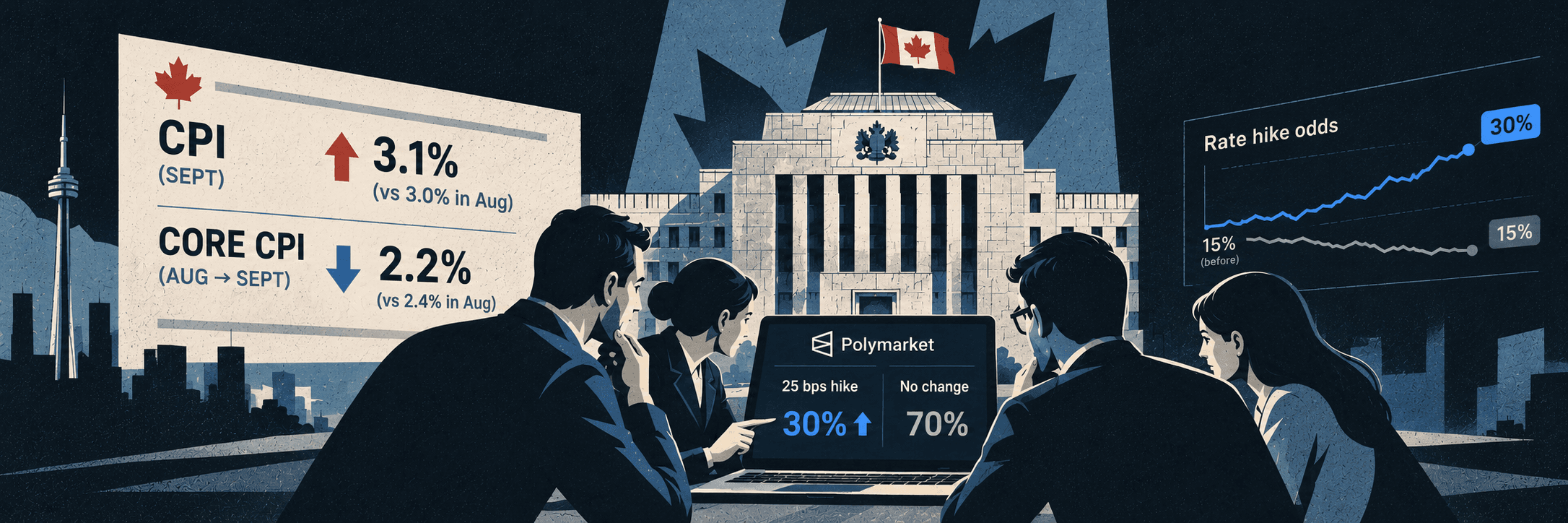
Statistics Canada published on Monday a lower-than-expected September consumer price index of 3.1% versus a forecast of 3.2%. However, this was still an acceleration from August, when it published an annual CPI of 3.0%.
The increased inflation triggered a reaction from the market, with expectations for an October rate hike rising on prediction market platforms like Polymarket.
Odds for a no-change decision in October fell from about 88% on Sunday to 67% on Monday, while a 25-basis-point hike now has a 30% chance, up from 15% on October 18.
Contracts on the Bank of Canada raising interest rates by 25 basis points in October are going for about $0.31 per share, while a no-change decision is trading at about $0.68 per share.
Less than 24 hours ago, traders could buy a share of a yes on a 25-basis-point hike at $0.15, while a no-change decision was going for $0.87.
Are traders wrong to be pricing a hike decision that high?
First, the September CPI came in lower than expected, 3.1% versus 3.2% forecast. So, why do traders all of a sudden think the BoC is now more likely to hike than it was last week?
The spike in the 25-basis-point rate hike odds points to a sentimental reaction to the fact that the CPI rose by 3.1% in September compared to the previous month’s 3.0% rise. Any inflationary fears would have been priced in well ahead of the release on Monday, because an acceleration was expected. StatCan attributed the rise in the September CPI to rising gasoline prices.
Second, the Bank of Canada’s core CPI in September increased by 2.2%, compared to a 2.4% rise in August, registering a deceleration. The core CPI excludes the more volatile food and energy prices, thus providing a clearer picture of where underlying inflation stands.
According to StatCan, gasoline prices increased by 27.8% in September compared to a 22.8% increase in August, leading to the slight acceleration in general inflation.
Overall, energy prices also accelerated in September, rising 19% compared to a change of 15.4% in August.
The Bank of Canada leans heavily on CPI data as guidance when making interest rate decisions. Therefore, current rate hike odds are highly overpricing the likelihood of that decision, whereas no-hike odds now look a little discounted, thus providing a better risk-reward trade-off.

This page does not constitute investing advice. Prediction markets and/or gambling may result in loss of funds. You are advised to conduct your own due diligence before taking any action.